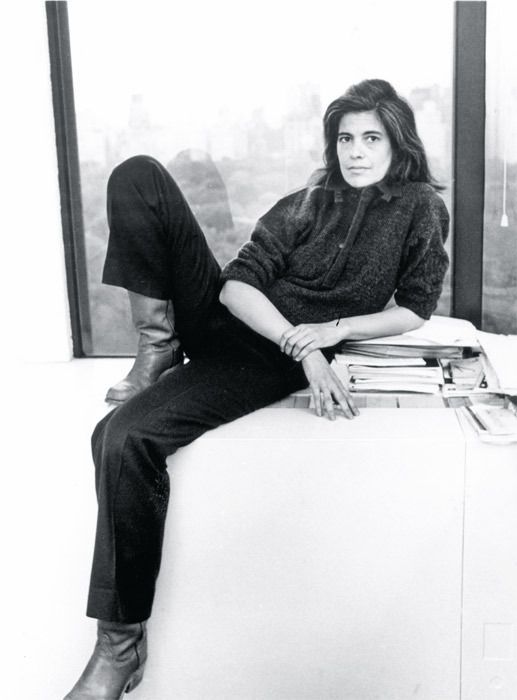
Susan Sontag, born in January 16th, 1933, was and remains an inspiration for women who wish to write.
A woman with too many accomplishments, like the ones Sontag has under her wing, seem daunting: even to professional writers. Multiple degrees from prestigious colleges, bestowed fellowships, and several major works written and published under her name.
Despite her extensive accomplishments and status in the field of literature, she is an inspiration to many. Yes, to women who wish to write, but also, to women of all age demographics.
If you type «Susan Sontag» on Pinterest, one of the first quotes that pops up is from one of her journals.
As mentioned, her work is extensive. There are college courses dedicated to discussing her work. Yet, in this blog, I want to focus on her renaissance in the modern world. There is a reason why recent content online that talk about Sontag focus on her journals.
Unlike her more professional works, her journals are more messy. Yet, the most beloved by her audience. Her journals are a sort of self-portraiture, an ongoing investigation deep into Susan Sontag’s psyche.
In one of her journals, she wrote:
«I’m chasing myself (I’ve been for years). (As Consciousness is Harnessed to Flesh: Journals and Notebooks, 1964-1980; February 17th, 1970)
This is one of the reasons why her writing, meant to be private, resonates the most with her modern audience. She does not censure herself, and allows herself to be vulnerable.
But what does the above clipping have to do with women writing? Merely everything. She is accessing herself in a very intimate level, and discovering who she is through her writing.
In the clipping I want to focus on, and that I think more women writers should read, is the following.
In a diary entry dated Dec. 3, 196, Susan Sontag describes what the types of people the writer is supposed to be. Almost in a cryptic manner, Susan Sontag is giving her (unbeknownst to her, as Sontag’s diaries were published after her passing ) audience instructions on how to be a writer. The list goes as follows:
The writer must be four people:
1. The nut, the obsédé
2. The moron
3. The stylist
4. The crytic
1 supplies the material; 2 lets it come out; 3 is taste; 4 is intelligenceA great writer has all 4 – but you can still be a good writer with only 1 and 2; they’re most important. (Reborn: Journals and Notebooks, 1947-1963)
Obsédé is the French word for an obsessed person. Sontag means that a writer is naturally an obsessed person. A person that overthinks or plays situations in their head over an over. An obsession over anything that plagues the writer and that she cannot ignore.
The moron is, well, a moron. This line would be funny if it did not confuse scholars and writers who want to decipher the meaning of it. To me, at least, it means that writers tend to overanalyze their words that it ends up backfiring. Susan Sontag’s works are beloved over how imperfect they are. They do not mean to be pretentious. They are created messily instead of constructed out of restrained creativity.
The stylist is a person who embellishes their words. The one that makes the words land and resonate just right with the reader. Be it a poet who builds up a metaphor, or who uses other poetic devices (more on that in future blog) to enhance the experience of reading their work. This is taste.
And, finally, the critic. We all have an inner critic, and we tend to be our harshest critics. The critic might pass for the obsédé, except for one tiny detail: the obsédé creates ideas, the critic tends to destroy them. An idea might be too overanalyzed, too criticized, that the writer might opt to delete their entire idea altogether. To Sontag, the critic might be intelligent, but sometimes it can be destructive.
Sontag says that the obsédé and the moron are the most important things a writer can be. I agree with her. A writer is often too obsessed with something –an idea, a feeling, a situation, a person– to the point of creation. The writer must follow her literary instincts and build something from the ground up, the embellishments can come later.
A writer should create messily instead of forcing herself to write curated and picture-perfect words. (Which is also, coincidentally, one of the goals of the magazine).
 Serpent's Tongue Journal
Deja un comentario